

General practice is under pressure from every direction. One of the biggest constraints practices face is not a lack of technology, but a lack of integrated tools in primary care.
Practices continue to adopt emerging technologies to help better manage access, reduce call volumes, streamline admin, and support clinicians. A study from the Nuffield Trust found that 28% of GPs in the UK were using AI tools as of late 2025. In the last five years, we’ve seen the introduction of Online Consultations, digital assistants, ambient scribes — each solving a genuine problem. But when they operate in isolation, they can often shift work rather than remove it.
This is the uncomfortable truth. Fragmentation does not just add friction, it quietly reshapes how demand is prioritised, how risk is managed, and where clinical time is lost. The future of general practice depends on integrated tools in primary care. Not integration as a technical concept, but integration as how patient intent moves from first contact to clinical action without being reinterpreted, retyped, or recovered.
Fragmentation is creating hidden workload
Patient requests arrive through phone calls, online forms, voice interactions, messages, and front-desk conversations. Each route captures different information, in different formats, with different levels of structure. Staff spend time filling gaps, clinicians chase missing context, and decisions are made with partial visibility.
This work is largely invisible. It does not appear on appointment lists or activity dashboards. It shows up as callbacks to clarify details that should have been captured once. It shows up as duplicated requests because information landed in the wrong system. It shows up as weaker audit trails and growing clinical risk.
This is not a failure of people adapting badly to technology. It is what happens when practices are forced to act as the integration layer between disconnected tools. Every workaround is staff time absorbed, attention split, and responsibility blurred.
Integrated tools in primary care remove that burden by design. When patient intent is captured once and flows through connected systems, the work of correction disappears. Not because staff work harder, but because the system stops asking them to compensate for its gaps.
Access is omni-channel, so why aren’t workflows?
Patients do not experience access in neat categories. They move between channels based on urgency, confidence, availability, and support. A patient may call first thing in the morning, submit a digital request later, or ask staff to help them complete a form. Access is already omni-channel. The problem is that most practice workflows still treat each channel as separate.
Truly integrated tools in primary care mean that every route into the practice leads to the same structured outcome. The channel becomes irrelevant, it is the workflow that becomes critical.
For example, when a patient requests a callback through a digital assistant like Surgery Assist rather than waiting on hold, that request does not sit in isolation. Instead, it flows directly into the telephony workflow, managed in the same way as other calls. Demand is captured digitally, but delivered through familiar systems, reducing pressure on phone lines without creating a new process for staff to manage.
The same principle applies to Online Consultation request data. Whether information is gathered by a Voice Agent interaction, a web form, or entered by staff on behalf of the patient, it can land in one place, in one format, ready for triage. That consistency removes early variability — and with it, inequity — from the patient journey.
This is not about replacing channels or forcing digital-first behaviour. It is about making channels interchangeable from a workflow perspective, so access routes do not determine the quality or safety of care.
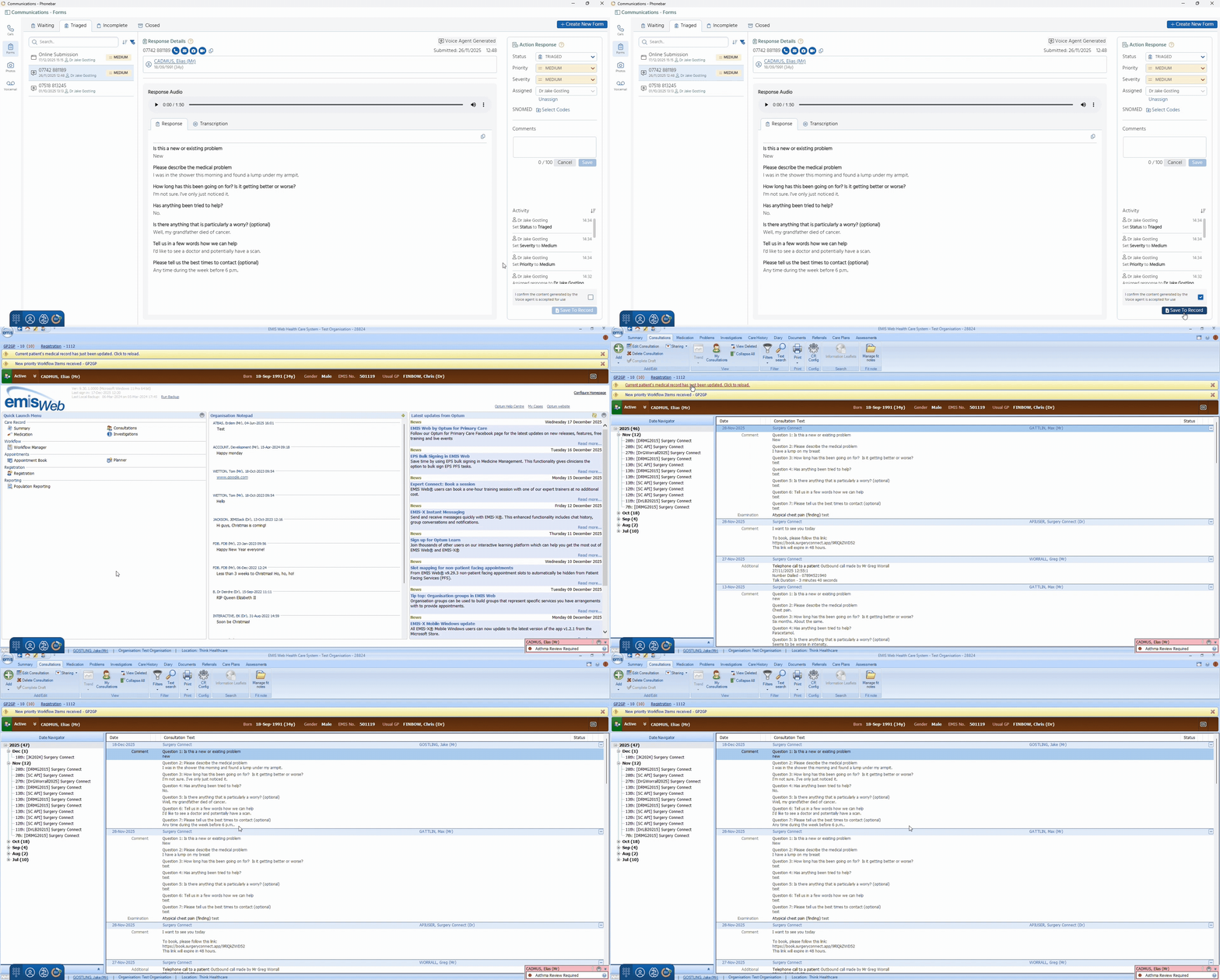
Saving Online Consultation request (captured via Voice Agent) to record
Why standalone tools fall short
Technology only helps when it fits into the reality of day-to-day work. In general practice, that reality is shaped by a small number of core systems that teams rely on under pressure.
Every additional login, inbox, or dashboard fragments attention. Staff switch context, reorient themselves, and carry risk across systems that were never designed to speak to each other.
Integrated tools in primary care reduce this friction. When callback requests, Online Consultation data and triage decisions are all handled within the same environment, teams gain a single view of demand. There is now a consistent way to prioritise requests, and a clear audit trail from first contact to outcome.
This is not just about saving time. It reduces cognitive load during peak periods, when mistakes are most likely. It also forces a discipline that standalone tools avoid: alignment around how work actually moves through the practice.
The trade-off is real. Integration can limit local variation and bespoke workarounds. It requires saying no to tools that solve niche problems but create system-wide drag. When these elements are connected, they form a joined-up access model that reflects how practices actually work, not how individual products are sold.
Related read: 5 ways AI medical scribes improve GP workflows
Safe automation depends on clinical system integration
Automation in primary care only works when it is governed. Capturing information is not enough. Practices need confidence that clinical content is handled safely, reviewed appropriately, and recorded correctly.
This is where integration with core clinical systems becomes critical. When clinician-approved documentation can be written directly back to the patient record, automation stops being an admin shortcut and becomes part of routine care delivery.
Surgery Intellect, powered by TORTUS, achieving IM1 assurance for file-to-record is an important example of this. It confirms that structured notes, once reviewed by a clinician, can be filed directly into EMIS and TPP systems. This applies across both face-to-face and telephone consultations, ensuring that a significant proportion of patient interactions are captured accurately without extra steps.
The value here is not just time saved. It is consistent, safe and auditable. Having integrated tools in primary care ensures that automation strengthens clinical governance rather than undermining it.
Related read: Safe AI in primary care: setting the standard
Integration is how care navigation becomes intelligent
When access, triage, communication and documentation are connected, practices move from reacting to demand to managing it.
- Patient intent is captured clearly and early
- Inappropriate requests are filtered or signposted before they consume clinical time
- Clinical requests arrive with context that supports safer prioritisation
- Follow-up is targeted, not blanket
This is how intelligent care navigation emerges in practice. Not as a single system switch, but as a sequence of integration decisions that remove friction step by step. Linking digital assistants with telephony, aligning consultation capture across channels, and embedding documentation safely into clinical systems.
The result is a joined-up access layer that supports patients, protects staff time, and improves safety.
Integrated tools in primary care as the direction of travel
The future of general practice will not be defined by who has the most digital tools. It will be defined by who has the best connected ones.
Integration is what turns individual technologies into a system. It is what enables equity of access, safer triage, and sustainable workloads. It is also what makes intelligent care navigation possible in the real world of primary care.
This direction of travel is already clear. Practices are moving away from siloed bolt-ons and towards workflows that span voice, digital and clinical systems. The work happening now to connect these elements is not just incremental improvement. It is laying the foundations for how general practice will function in the years ahead.