

Medical device classifications explained

As AI becomes more common across the NHS, you’ve probably come across terms such as Class I Medical Device, UKCA marked or Class IIa certified (under UK MDR 2002).
But what do they actually mean?
Medical device classifications help determine the level of regulatory oversight a product requires before it can be used in healthcare. They exist to protect patients while supporting innovation, ensuring healthcare technologies are safe, effective and fit for their intended purpose.
Whether you’re evaluating AI-powered documentation tools, digital triage software or clinical decision support systems, understanding these classifications can help you make more informed decisions.
What is a medical device?
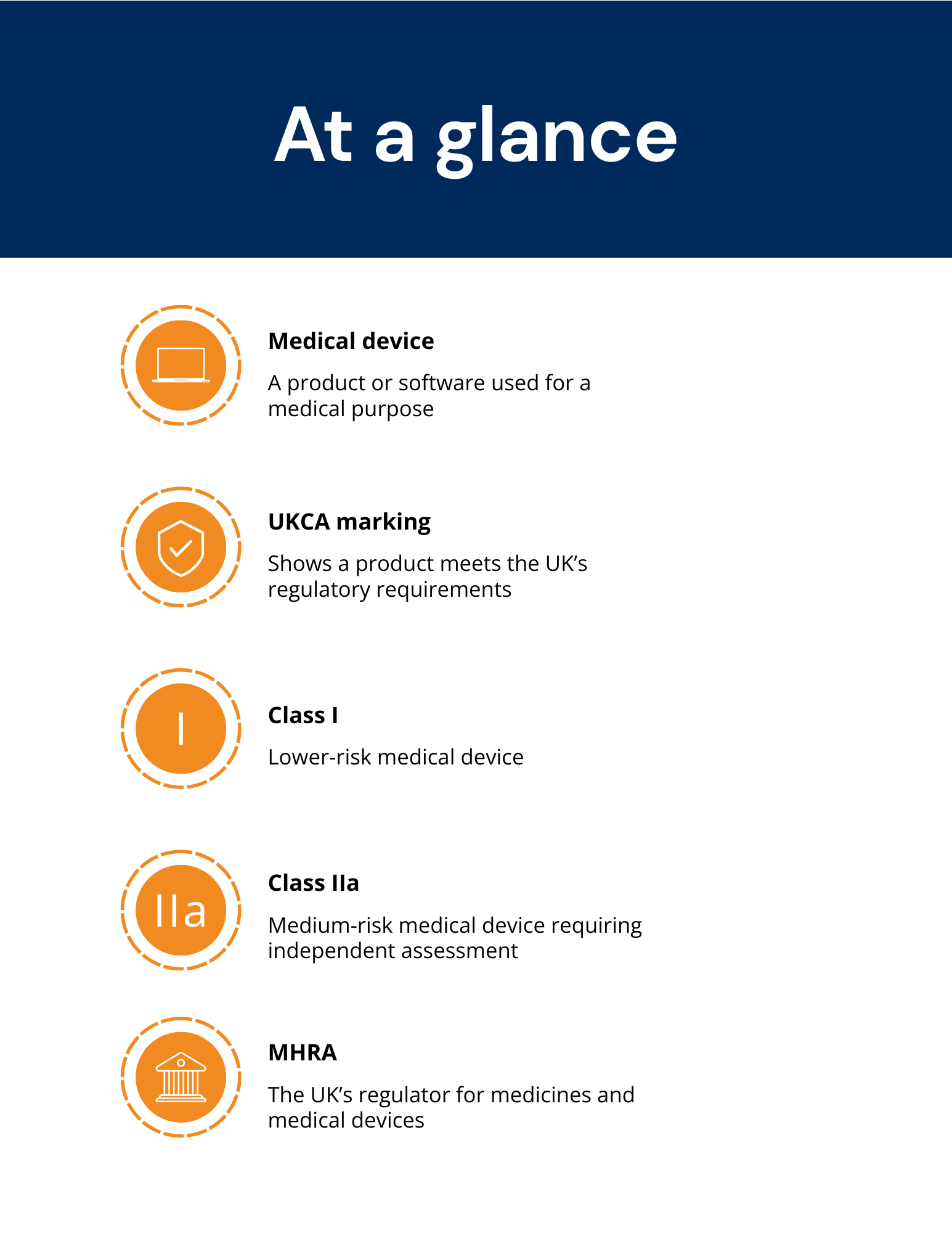
NHS England defines a medical device as “any instrument, apparatus, appliance, software, material, or other article, which is intended for human use that performs a medical purpose, such as diagnosing, monitoring, or treating a medical condition. This could be hardware, software, or appliances ranging from sticking plasters to defibrillators.”1
Medical devices include familiar products such as blood pressure monitors, thermometers, ECG machines, surgical instruments, and implantable devices. Increasingly, software can also be classed as a medical device.
This includes some AI-powered healthcare technologies, depending on what they are designed to do and the level of risk associated with their intended use.
Importantly, not all healthcare software is a medical device. Classification depends on the product’s intended purpose and how it influences patient care, rather than whether it simply uses AI.
What is UKCA marking?
The UKCA (UK Conformity Assessed) mark shows that a medical device meets the relevant regulatory requirements for use in Great Britain.
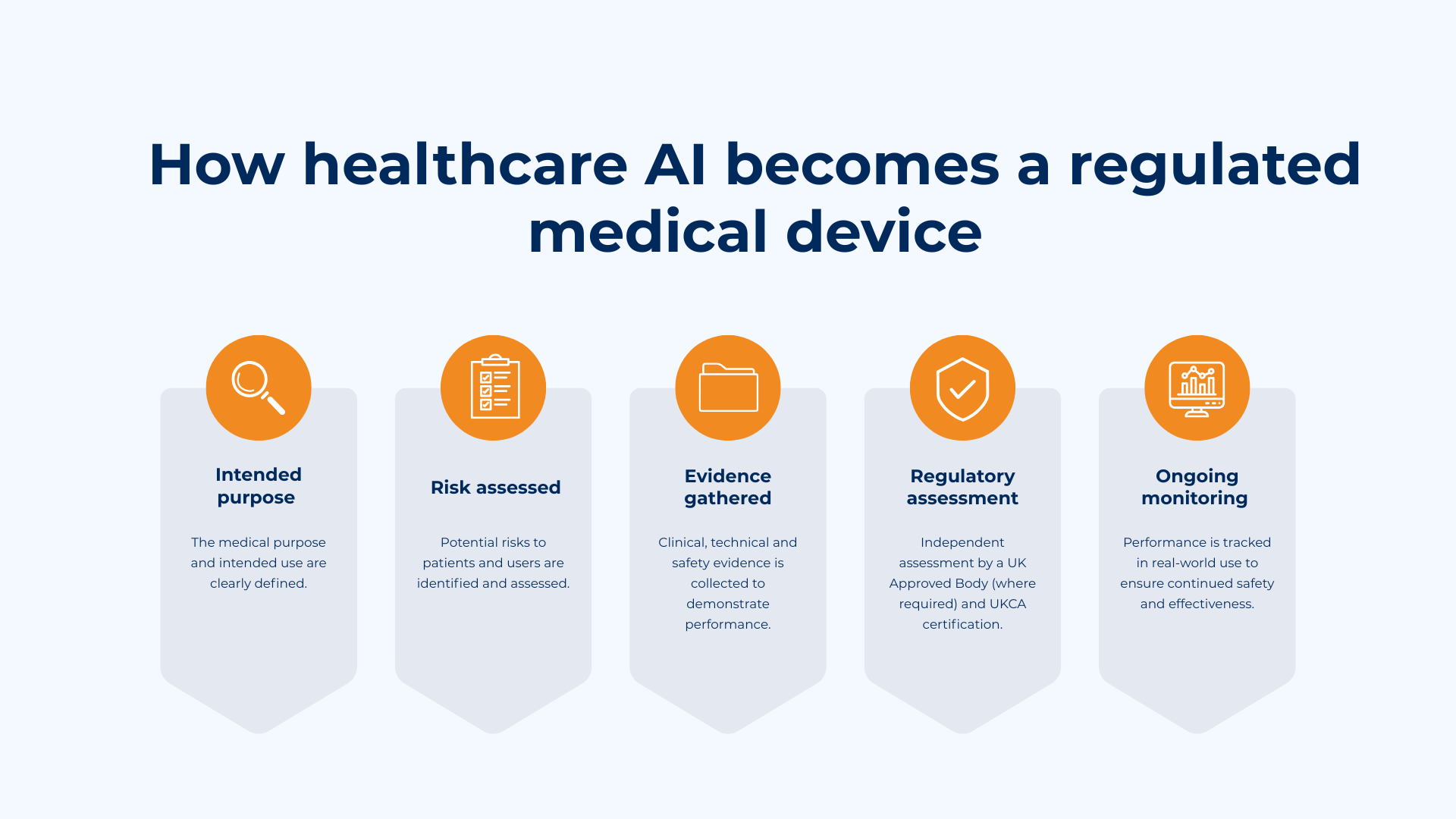
Depending on the type of device, manufacturers may need to demonstrate:
- Clinical evidence
- Technical documentation
- Risk management
- Quality management systems
- Independent assessment
- Ongoing monitoring after launch
UKCA marking does not mean a product is risk-free or endorsed by the NHS. It demonstrates that it has met the regulatory requirements appropriate for its intended purpose.
How are medical devices classified?
Medical devices are grouped into four main classes based on the potential risk they present to patients and users.
Generally, the higher the classification, the greater the level of regulatory oversight required.
| Classification | Risk level | Examples |
| Class I | Low | Some healthcare software, administrative workflow tools, non-invasive medical devices, ambient voice technology |
| Class IIa | Medium | Many AI-powered clinical support tools, diagnostic software, TORTUS ambient voice technology |
| Class IIb | Medium to high | Infusion pumps, ventilators, higher-risk diagnostic software |
| Class III | Highest | Pacemakers, implantable heart valves and other life-supporting or implantable devices |
💡Good to know: A higher classification does not mean a product is “better”. It reflects the potential clinical risk associated with its intended purpose and therefore the amount of regulatory oversight required.
Related read: Software and artificial intelligence (AI) as a medical device
What is a Class I medical device?
Class I devices are generally considered lower risk.
Many Class I medical devices can be self-certified by the manufacturer, although they must still comply with UK medical device regulations and maintain technical documentation.
Some technologies that support administrative or workflow processes fall into this category because they do not make clinical decisions.
For example, X-on Health’s Workflow Agent technology is registered as a self-certified Class I Medical Device, reflecting its intended purpose within patient access workflows.
What is a Class IIa medical device?
Class IIa devices are medium-risk medical devices that require independent assessment before UKCA certification.
Manufacturers typically need to demonstrate:
- Clinical evidence
- Technical documentation
- Quality management systems
- Risk management
- Clinical safety processes
- Post-market surveillance
TORTUS, the technology powering Surgery Intellect, became the first ambient voice technology to achieve UKCA Class IIa certification in the UK. Although not typically required for this type of technology, TORTUS AI pursued Class IIa certification to demonstrate its commitment to clinically safe, trusted AI. Independent assessment by a UK Approved Body involved rigorous review of extensive technical, clinical and safety evidence, providing healthcare organisations with an additional level of assurance.
Related read: TORTUS AI: Years in the making
Why do medical device classifications matter?
Medical device classifications help healthcare organisations understand:
- How a product is intended to be used
- The level of regulatory oversight involved
- The evidence supporting it
- The safeguards built into its design
- The monitoring required after deployment
This is becoming increasingly important as AI adoption grows.
In 2026, research published by the Medicines and Healthcare products Regulatory Agency (MHRA) found that patients and healthcare professionals broadly support AI in healthcare, provided technologies are safe, transparent and subject to appropriate regulation and ongoing monitoring.
The findings also highlighted that patients expect human oversight and clear accountability when AI is used in healthcare.
Does a higher classification mean a product is safer?
No.
This is one of the biggest misconceptions.
Medical device classifications reflect the potential risk associated with a product’s intended purpose, not its overall quality.
A Class IIa medical device is not automatically “safer” than a Class I medical device.
Instead, it means they are designed for different purposes and are regulated accordingly.
When evaluating healthcare technology, classification should always be considered alongside:
- Clinical evidence and compliance with clinical safety standards (for software medical devices)
- Information governance
- Cyber security
- Integration
- Usability
- Clinical oversight
- Ongoing support
Building trust into healthcare technology
Regulation is only one part of encouraging trust in healthcare technology.
The most effective solutions combine strong governance with practical safeguards that keep clinicians in control.
For example, Surgery Intellect is powered by TORTUS, whose protective clinical safety layer, The Shell, compares AI-generated consultation notes against the original consultation before they are presented to the clinician. The Shell removes almost 93% of AI hallucinations before the draft note reaches the clinician for review.
Importantly, clinicians remain in control throughout the process. Every note, referral letter and clinical code must be reviewed, edited where necessary and approved by the clinician before anything is added to the patient record.
This reflects a wider principle that is becoming increasingly important across healthcare: AI should support clinical judgement, not replace it.
Questions to ask when evaluating healthcare technology
Before investing in healthcare technology, ask:
✔ Is it classed as a medical device?
✔ What medical device classification does it have?
✔ Does it have UKCA certification where required?
✔ What evidence supports its effectiveness?
✔ Who reviews AI-generated outputs?
✔ How is patient data protected?
✔ What ongoing monitoring or post-market surveillance takes place?
✔ How does it integrate into existing workflows?
These questions can help ensure you’re evaluating technology on more than features alone.
Learn more about AI in healthcare
Medical device classifications are one part of understanding healthcare technology.
Trust also depends on transparency, governance, human oversight and continuous monitoring.
Read next: AI in healthcare: patients are ready, but trust comes first
Frequently Asked Questions
Is AI software always a medical device?
No. AI software is only regulated as a medical device if its intended purpose falls within the definition of a medical device under UK regulations.
What is the difference between Class I and Class IIa?
Class I devices are generally lower risk and can often be self-certified. Class IIa devices present a higher level of potential risk and require independent assessment by a UK Approved Body before UKCA certification.
What does UKCA stand for?
UKCA stands for UK Conformity Assessed. It indicates that a product has met the relevant regulatory requirements for use in Great Britain.
Does UKCA mean a product is approved by the NHS?
No. UKCA marking demonstrates compliance with UK medical device regulations. NHS organisations still carry out their own procurement and evaluation processes.
Why is human oversight important for AI in healthcare?
AI can support clinicians by reducing administrative burden and improving efficiency, but clinical judgement remains essential. Human oversight helps ensure decisions remain safe, accountable and centred on patient care.
Unlock the potential of online healthcare
Partner with us to unlock a more efficient healthcare system with a truly connected digital front door, and build your practice around smarter, joined-up care navigation.