


Flu clinics can place significant pressure on general practice long before the first patient arrives.
That pressure can show up at reception days or weeks earlier: patients checking whether they are eligible, asking how to book, querying an invitation or trying to change an appointment. It can appear again on clinic day when a late cancellation leaves capacity that is difficult to refill.
This is why flu clinic preparation in general practice is not simply about opening enough appointment slots. A practice can fill a clinic and still create unnecessary work if patients need to call to understand the invitation, call again to book and contact the practice again when their plans change.
The bigger challenge is designing the journey around the clinic.
When patients know whether they need a vaccination, where to find information and how to take the next step, practices can spend less time managing avoidable contact and more time supporting people who need help.
Flu clinic preparation in general practice starts before invitations
Before practices invite patients to book, it is worth looking at the journey from the patient’s perspective.
Patients may have questions about eligibility, clinic timings, location, allergies or what they need to bring. They may not know whether they should book through the practice, the NHS App or another route. Some will act as soon as they receive an invitation. Others will need more information first.
Designing these choices around real patient needs is part of providing equitable patient access: digital convenience should sit alongside clear human support.
Before launching invitations, practices should consider:
- What information will patients need before booking?
- Which booking routes will be available, and is it obvious which one to use?
- How will patients who cannot use a digital route get support?
- What happens when a patient needs to cancel?
- How will released capacity become available to another patient?
- Who will monitor uptake, questions and missed appointments as clinics begin?
These are not separate operational tasks. Each stage affects the next.
Give patients clear answers before they need to call
Not every flu-related contact requires a conversation with the practice.
Clear, up-to-date information can help patients answer general questions about the seasonal programme and understand what to do next. It should be easy to find, written in plain language and reviewed as clinic arrangements change. Because eligibility and delivery arrangements vary across the UK, practices should refer to the latest flu guidance for England, Scotland, Wales or Northern Ireland, alongside clear local information on clinic dates, locations and booking routes.
Practices also need to avoid assuming that every patient starts with the same knowledge. An invitation that seems obvious to someone who books a flu vaccination every year may be much less clear to somebody who is newly eligible or unsure which service they should use.
Digital support can help, but it needs clear boundaries.
For example, digital assistants such as Surgery Assist Lite can provide general flu information based on trusted national resources, alongside supplemental practice information. This can give patients another way to find answers without every routine question becoming a reception contact.
Practices remain responsible for checking the local information they provide, particularly clinic dates, locations and booking instructions. When the same questions keep appearing, that is worth noticing. Repeated contact may point to something earlier in the journey that needs attention.
Make the route to booking easy to follow
Patients are more likely to act when the next step is clear.
For many practices, this means moving beyond a general invitation that asks patients to contact reception. A direct booking route can give patients more control over when they attend while reducing the need to call the practice.
Surgery-Led Appointment Booking is one example. Practices can send selected patients an SMS with a link to available appointments, allowing them to choose a suitable flu clinic slot without calling the practice.
Tailored digital care navigation can also direct patients to a practice-approved booking channel based on the appointment they need. Surgery Assist Pro, for example, can signpost patients to the NHS App for a flu vaccination or another appropriate route. As the NHS App triage tool develops, local care navigation will remain important for helping patients understand the practical route available through their own practice.
But the principle matters more than the tool. Every additional access route has the potential to create another workflow for the practice. Maintaining patient choice should not mean creating disconnected processes that staff then have to reconcile.
Some patients will prefer to phone. Others may need support from a carer, family member or practice team. Whatever routes are available, it should be clear who they are for, what the patient needs to do and where they can get help if something does not work.
Help patients act on reminders and cancellations
A booked appointment is not always an attended appointment.
Patients forget, plans change and some people may no longer need their slot. Practices cannot prevent every missed appointment, but they can make it easier for patients to confirm or cancel before the clinic.
Outbound Voice Agents provide one way to offer another route. The automated agent is designed to call patients with a reminder, verify their identity and allow them to hear, confirm or cancel their appointment.
A voice option could be useful for patients who are less likely to respond to an SMS or use an online route, and should sit alongside rather than replace other ways of communicating. Any automated route should include a patient access pathway safety net, so patients who cannot complete it have a clear way to continue.
But making cancellation easier is only half the job.
A cancellation creates value only if the released capacity can be reused. If nobody sees the empty slot quickly enough, or another patient cannot book it, automation may simply tell the practice about unused capacity sooner.
That makes the process after cancellation an important part of flu clinic preparation in general practice. Who reviews released appointments? How quickly can they be made available again? At what point is a cancellation too late to refill?
Agreeing that process before clinics begin can prevent staff from having to improvise when clinics are at their busiest.
Treat patient contact as operational information
Flu clinic preparation in general practice should continue after invitations are sent.
Practices need to understand what is happening while clinics are running: which appointments are filling, where DNAs are occurring and what patients are still asking about.
Patient contact itself can be useful operational information.
If patients repeatedly ask how to book after receiving an invitation, there may be a problem with the wording or booking instructions. If questions focus on eligibility, the information available before booking may need to be clearer. If one clinic has a higher DNA rate than another, teams can look at its timing, reminder process or patient group.
The important shift is from simply counting activity to asking what the activity is telling you.
Data dashboards such as Surgery Insights can support this review by bringing together appointment type and DNA data alongside Surgery Assist query data. Practices can see how many patients have asked about flu appointments and use that information to identify where information or signposting may need to improve.
The aim is to spot friction while there is still an opportunity to do something about it, rather than simply report what happened once the programme has finished.
A clearer journey supports better flu clinics
Good flu clinic preparation in general practice is not about digitising every stage. It is about noticing where one stage creates unnecessary work for the next.
If an invitation generates avoidable questions, improve the invitation. If a booking route creates calls, examine the route. If cancellations leave capacity that cannot be reused, look at what happens after cancellation. If patients keep asking the same question, treat that pattern as something to learn from, not simply another contact to manage.
Technology can support different parts of this journey through patient information, direct booking, voice reminders and operational insight. But individual tools cannot compensate for a fragmented process.
The opportunity is to connect the stages: information, invitation, booking, reminders, attendance, cancellation and review.
For patients, that can mean less uncertainty about what they need to do. For practice teams, it can mean fewer avoidable contacts and a clearer view of where the journey needs attention.
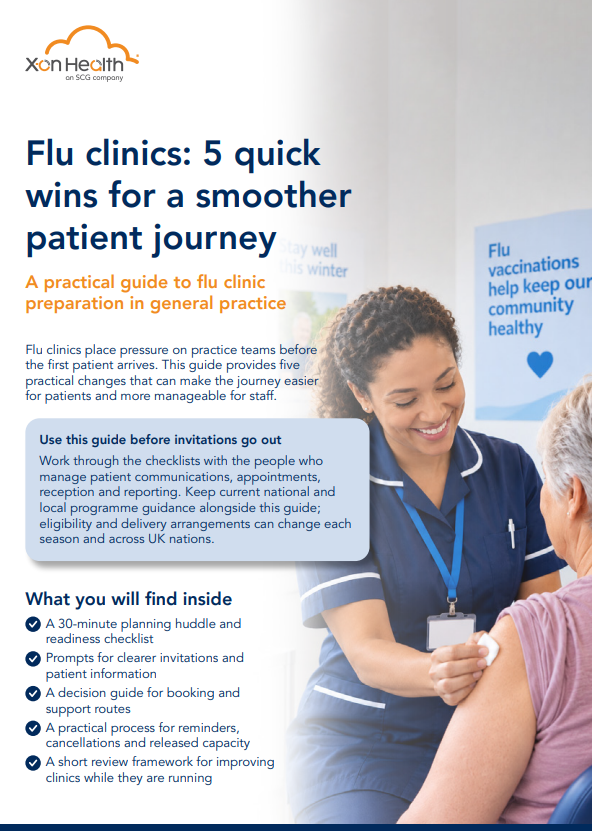
Make every stage of the patient journey easier to manage.
At X-on Health, your dedicated Customer Success Advisor can help you make the most of your tools and workflows during flu season.
Download our flu clinic preparation guide below for practical quick wins, a readiness checklist and prompts to review what is working as clinics run.