


Every practice knows the 8 am problem. Phone lines open, queues build quickly and patients contact the surgery through several routes, often unsure where to turn.
But the queues themselves are rarely the real problem.
Practices don’t usually struggle because demand arrives through multiple channels. They struggle because every channel creates a different workflow.
Effective triage in general practice cannot be treated as a standalone clinical process. It starts at the front door. When every patient request follows one coordinated pathway, practices can give patients a fairer way in while creating a more manageable day for staff.
Good triage in general practice is more than appointment booking
Good triage is not about filling appointments as quickly as possible. It is about helping each patient reach the most appropriate next step the first time.
For some, that will mean a same-day appointment. For others, it may be self-care information, a local service, a prescription request, an appointment with another member of the practice team or advice through the NHS App.
This is intelligent care navigation: understanding what a patient needs, then guiding them to the right route without creating unnecessary work for staff.
Before changing a triage model, practices need a clear picture of both demand and capacity. That means understanding not just who is contacting the practice, but when demand peaks, where duplicate requests occur, which contacts require clinical input and where staff repeatedly spend time gathering information that could have been captured at the start. This gives practices a stronger foundation for triage in general practice.
Many triage redesigns fail because they digitise existing bottlenecks instead of redesigning the pathway. Adding another access channel rarely fixes access if every route creates a separate workflow.
A useful way to think about this is through five connected areas: access, care navigation, demand management, patient communication and insight.
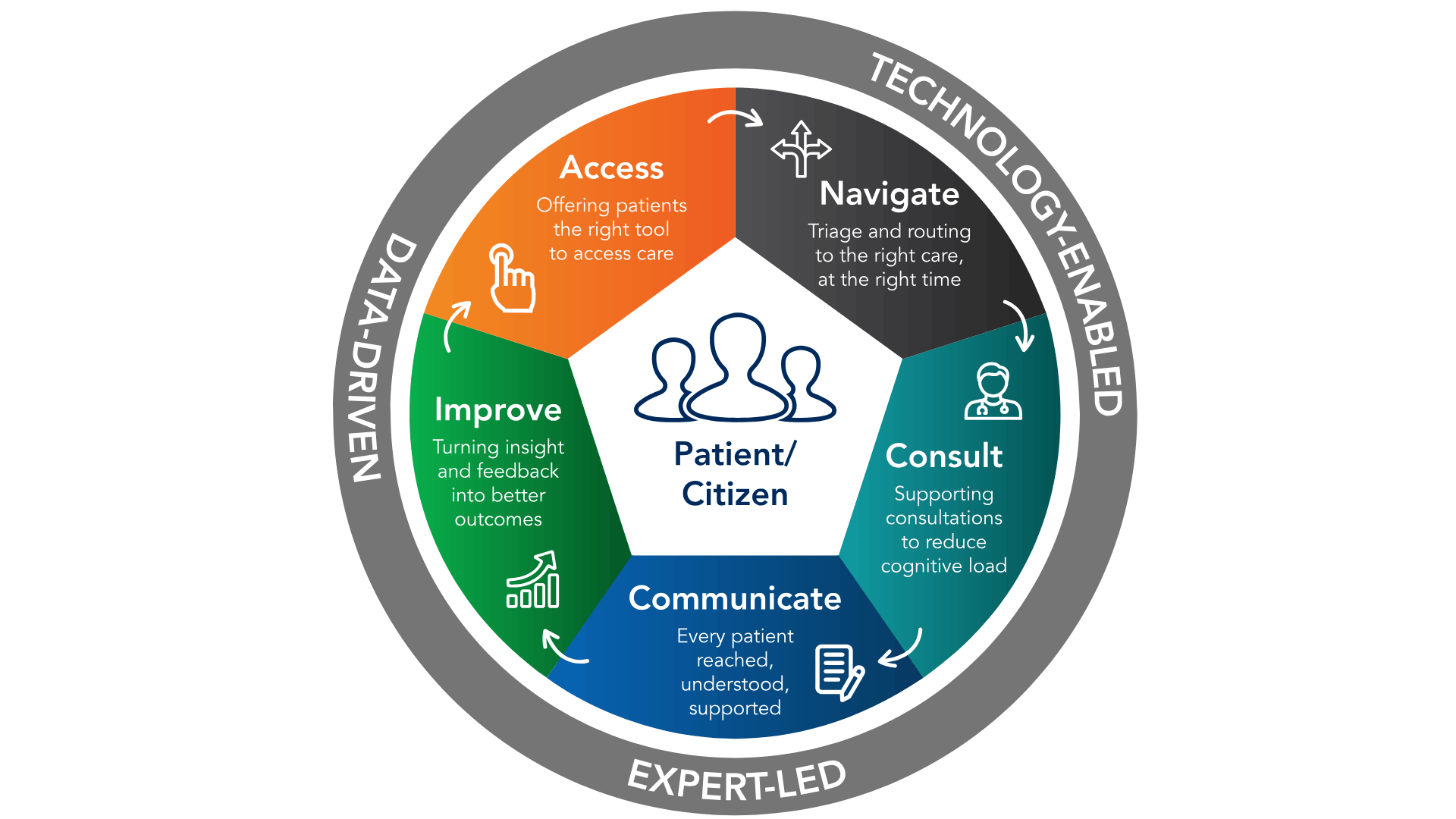
X-on Health’s intelligent care navigation model
Weakness in one area quickly creates pressure elsewhere. If patients cannot get through by phone, they may redial several times or submit the same request online. Or they may give up altogether. This is why patient access pathways need a safety net, so patients who cannot use one route still have a clear way to get help. For staff, if they can’t see every request in one place, prioritisation becomes harder and workload becomes less visible.
Choice without coordination isn’t access, it’s duplicated demand
There is no single access route that works for every patient.
At The Cambridge Practice in Aldershot, serving more than 22,000 patients, equitable access was a key consideration. The practice supports a diverse population. Many patients are comfortable using online services, while others prefer to phone or need extra support to get in touch.
Offering patients different ways to contact the practice is important. But each additional route can also create more work unless every request feeds into the same process. This is a central challenge of triage in general practice.
A fair access model retains the phone alongside digital routes and reception support. This reflects NHS England guidance ‘You and your general practice’, which states that patients should be able to contact their general practice by phone, online or in person, with requests assessed according to clinical need. The aim is not to push everyone online but to give patients genuine choice without creating disconnected systems behind the scenes.
An omni-channel approach helps achieve this. A patient may complete an online form, use a digital assistant, speak to a voice agent or talk directly to reception. Each route should lead into the same workflow, with the same information available to the team, rather than requiring staff to re-enter details or chase missing information.
At The Cambridge Practice, patients can still choose to speak to a medical call handler. Automation supports that choice rather than replacing it.
Bring every request into one clear workflow for triage in general practice
When requests arrive through one coordinated workflow, teams have a much clearer picture of the day ahead.
Structured information is available from the outset, whether the patient made contact online or by phone. Staff can see what is waiting, what has been triaged and what has been completed. This reduces manual administration, makes requests easier to follow and gives teams greater control over workload.
Technology should support clinical judgement, not replace it.
Automated tools can collect relevant information at first contact and direct requests into the appropriate workflow. The practice team still reviews every request, applies clinical judgement, determines urgency and makes the triage decision. Automation removes repetitive administration so clinicians and reception teams can focus on decision-making rather than repeatedly gathering the same information.
At The Cambridge Practice, requests are reviewed through a single communications window before being added to the duty doctor list and directed to the most appropriate clinician, team member or service.
As Claire Jackson, Digital Transformation Lead, explains:
“This has made triage simpler, improved signposting and given the team greater control.”
The Cambridge Practice: moving beyond the 8 am rush
Before redesigning its access model, The Cambridge Practice regularly saw up to 50 patients waiting in the phone queue from 8 am, with some waiting for more than an hour. The queue often remained high throughout the day, placing sustained pressure on patients and staff.
Rather than introducing a single new technology and hoping it would solve the problem, the practice first examined where demand was really coming from. Working alongside its Customer Success Advisor, the team analysed call peaks, demand patterns, staffing levels and optimised workflow performance before redesigning access gradually, responding to staff and patient feedback throughout.
One important lesson was that improving access is not simply about opening more channels. It is about ensuring every request enters the same coordinated pathway. This is what makes triage in general practice more manageable for teams.
The result is an integrated model combining Cloud telephony, digital care navigation, ambient voice technology and voice agents, all supported by operational insight. Patients now have several ways to contact the practice, but every request enters one workflow for assessment and management.
The changes delivered measurable improvements. DNA rates reduced from 8% to 3%, while NHS App use increased to 76%, above the average of 75%. Between January and May 2026, around 678 hours of administrative workload were redistributed across the practice, helping teams manage demand more effectively during ongoing staffing pressures.
For Claire, however, the biggest change is not simply better performance metrics. Teams now have far greater visibility of the day ahead, allowing them to prioritise work more confidently while helping patients reach the right care at the right time.
Read the full case study: Supporting intelligent care navigation at The Cambridge Practice
Better access can reveal hidden demand
One reality often overlooked in access transformation is that better access can initially make demand appear worse.
When barriers to contacting the practice are reduced, previously unmet needs often become visible. That does not necessarily mean more patients are becoming unwell. It means more patients are finally finding it easier to ask for help.
This is why practices need to measure demand carefully rather than assuming every increase represents failure. Better visibility allows practices to understand where pressure genuinely exists and refine pathways accordingly.
Use data to keep improving triage in general practice
A triage model is never finished at go-live. Patient behaviour changes, demand fluctuates and small operational issues can quickly become significant sources of pressure.
Practices should regularly review call peaks, missed and abandoned calls, demand by channel, appointment utilisation, waiting times and the types of requests entering the practice. Looking at these measures together provides a much clearer picture than focusing on any single metric in isolation.
For example, an increase in abandoned calls is not always a negative outcome. It may indicate that patients are successfully choosing a self-service route rather than waiting in a queue. The key is to interpret those figures alongside patient feedback, outcomes and demand across every access channel.
Before redesigning triage, every practice should ask:
- Where does demand actually originate?
- How many duplicate requests do we receive?
- Which requests require clinical input?
- Where are staff repeatedly collecting information that patients could provide themselves?
- Which bottlenecks are operational rather than clinical?
Good triage in general practice is not about removing phone access or asking every patient to navigate care in the same way. It is about designing a joined-up front door where every request enters one coordinated workflow, patients have genuine choice and practice teams can apply their clinical expertise where it adds the greatest value.
Want to see The Cambridge Practice’s approach to access and good triage in general practice?
Watch the webinar recording below.