


A shorter phone queue. More patients using online services. Fewer missed appointments.
For GP practices, these are encouraging signs of improvement. But do they tell the whole story?
A patient might reach the practice more quickly but still struggle to navigate the telephone menu. Another might successfully submit an online request but remain unsure what happens next.
Operational data shows how services are performing. GP patient feedback helps explain what that performance means for the people using them. Together, they can help practices identify hidden frustrations, understand what is working and make more informed decisions.
Why GP patient feedback matters beyond complaints
The Care Quality Commission (CQC) and Healthwatch England’s Share for Better Care campaign encourages people to share their experiences of health and social care, whether positive or negative. Research supporting the campaign found that only 20% of people surveyed had given feedback about health or social care in the previous two years. Among those who had not, 26% worried their feedback would not be heard, while 22% feared it could negatively affect their care.
For practices, this raises an important question: how much of the patient experience goes unreported?
Complaints can highlight serious concerns, but everyday frustrations may be less visible. Patients might repeatedly ask whether an online request has been received, for example, without formally raising an issue. These questions can reveal communication gaps that performance figures alone would not identify. GP patient feedback is most valuable when used to understand everyday experiences, not just respond to complaints.
What can operational data tell you, and what might it miss?
GP practices can measure how patients interact with their services through call reporting, appointment activity and digital engagement. Solutions such as Surgery Insights bring this operational information together, helping teams identify demand patterns, review workflows and understand the impact of changes. However, positive trends do not always mean every patient is having a positive experience.
Consider three examples:
- Call waiting times fall: Patients get through faster, but some still find the telephone menu confusing
- Online requests increase: More patients use digital services, but some remain uncertain about response times
- Missed appointments decrease: Attendance improves, but patients may still struggle to cancel or rearrange appointments
These improvements are valuable. However, using reporting to improve patient access is about more than tracking performance. GP patient feedback can help practices understand whether positive trends reflect a better experience and where further changes may be needed.
Finding the hidden causes of repeat contact
Consider a patient who submits an online request and receives confirmation. The request has gone through, but the message does not explain when to expect a response. Unsure whether anyone is reviewing it, the patient telephones the practice to check. The digital process worked, yet the patient has contacted the practice twice about the same issue.
By comparing recurring comments with call patterns, online activity and questions received by reception teams, practices may identify where patients need clearer information. For example, helping patients understand what happens after submitting a request could reduce uncertainty and prevent unnecessary follow-up calls.
Sometimes, reducing unnecessary contact does not require a new system or major workflow change. A clearer confirmation message may be enough to prevent confusion and an additional telephone call.
Are you hearing from the patients who face the greatest barriers?
GP patient feedback in general practice also raises an important question: whose experiences are being heard?
Patients comfortable using online services may find digital surveys straightforward. Others may face barriers related to language, disability, digital confidence or access to technology. If feedback mainly comes from people who already find services easy to use, practices risk overlooking those who struggle most. This is particularly important when considering equitable patient access across digital, telephone and in-person routes. Patients may face different barriers depending on their circumstances.
Practices can broaden participation through Patient Participation Groups (PPGs), accessible surveys, in-person conversations and engagement with local community organisations. It also helps to ask about specific experiences rather than relying solely on satisfaction scores. For example, low digital uptake does not necessarily mean patients prefer telephone contact. Some may be unaware of the online option or need support to use it.
Understanding these differences helps practices avoid making assumptions about patient preferences.
Turning feedback and data into practical improvements
Collecting feedback is only the beginning. Its value comes from connecting what patients say with operational evidence and staff experiences. Rather than creating another reporting exercise, practices can start with one recurring concern and ask:
- What are patients telling us? Look for repeated comments, questions and positive experiences
- What does the data show? Review relevant call, appointment or digital activity
- What are staff noticing? Check whether reception and clinical teams recognise the issue
- What could we change? Identify a manageable improvement to communication or workflows
- Has it worked? Monitor the relevant measures and ask patients whether their experience has improved
For example, if patients report difficulties cancelling appointments, a practice might review its website instructions and telephone options. It could then monitor cancellation activity and gather further feedback to assess the change. The aim is to make practical improvements based on evidence rather than assumptions.
Closing the feedback loop
Patients also need to know their views have been considered.
In the CQC and Healthwatch England research, 62% of respondents said they would be more likely to give feedback if they knew it would help create positive change in their community. A simple ‘You said, we did’ update on the practice website, noticeboard or patient newsletter can show what has changed following patient comments.
Not every suggestion will lead to action. Practices must balance patient preferences with clinical priorities, safety and available resources. However, explaining decisions can still demonstrate that feedback has been heard and encourage patients to contribute in future.
Better decisions start with the full picture
Faster calls, greater digital uptake and fewer missed appointments are useful measures of progress. But they cannot tell practices everything about the patient experience.
Data helps identify what is happening. GP patient feedback helps explain why it matters and what might need to change.
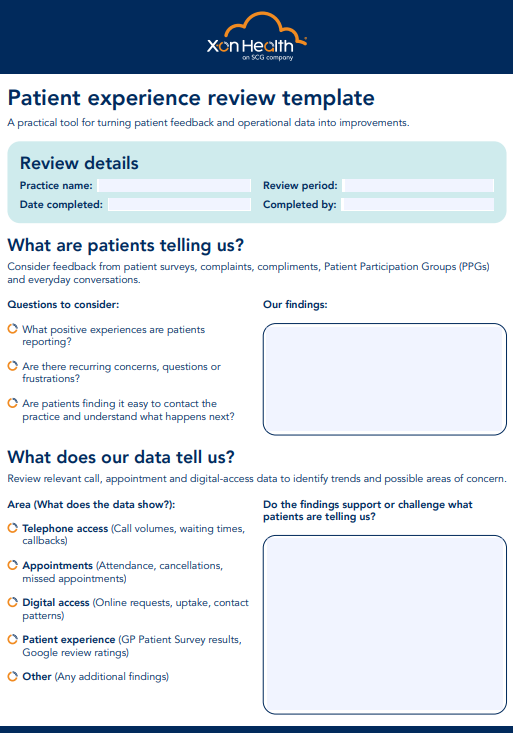
Turn GP patient feedback into meaningful improvements
Understanding patient experience means looking beyond the numbers. Bringing feedback and operational data together can help your practice identify concerns, understand barriers and agree what to improve.
Download our free patient experience review template and ready-to-use ‘You said, we did’ communications template to help your team turn feedback into action and show patients what’s changed.