


By the time the telephone phone queue builds, some of the work reaching reception has already been shaped by what patients could find out beforehand.
One patient calls because they are unsure whether a pharmacist can help. Another wants to know how to request support while the practice is closed. Someone else needs to cancel a booked slot but cannot find a simple way to do it.
Each contact has a reason. Taken together, reception teams can be left to explain routes and arrangements while patients who need an appointment wait.
Improving patient access in winter means handling this demand alongside the rise in seasonal illness. Practices cannot prevent winter demand, but they can look at where uncertainty creates extra work and where available appointment time risks going unused.
NHS England’s 2026/27 winter planning guidance calls for local plans built on demand and capacity analysis, with sufficient provision across primary care, community pharmacy and out-of-hours services. For practice managers, part of making that provision work is helping patients understand which option to use and how to reach it.
Understand what is bringing patients into the queue
A rise in calls tells a practice that more people are making contact. It does not, on its own, explain what support they need.
Some patients need clinical assessment. Others need help navigating a service, completing an administrative task or understanding advice they have already received. Treating all of this as one increase in demand makes it harder to decide where to act.
Reception teams can offer useful context. Which questions are they answering repeatedly? Are patients unclear about pharmacy services, requesting help through several routes or calling because online information does not explain the next step?
Surgery Assist, a digital assistant available on your practice website 24/7, helps patients find information and navigate care options. Its query data, available through Surgery Insights, can reveal common questions and when patients seek information, including outside opening hours. Alongside call patterns and staff feedback, this gives managers a broader view of the needs shaping patient access in winter.
For example, repeated questions about opening hours may point to information that is missing or difficult to find. Questions about pharmacy services may suggest patients need clearer local instructions. Reception staff can then help explain what patients find confusing and where they need personal support.
Combining these sources helps practices choose a specific improvement, rather than responding to every rise in contact by adding more telephone cover.
Turn winter advice into a practical next step
Better information can support patient access in winter, but only if it helps someone decide what to do.
National NHS advice gives patients a trusted starting point for common seasonal illnesses. However, knowing that a pharmacist may be able to help is different from knowing how to access the relevant local service. This is where local care navigation alongside national guidance matters: a patient who cannot work out the next step may still contact the practice for clarification.
Providing clear patient access in winter should therefore connect advice with action. Alongside trusted self-care resources, patients need practical guidance on local services, practice contact arrangements and where to seek help outside opening hours. Information should also make clear when further help is needed, so patients are supported to make an appropriate choice.
Digital assistants on your website can help make this information easier to find. Surgery Assist Lite, for example, can provide answers from trusted national resources alongside supplemental practice information. Where more tailored navigation is needed, Surgery Assist Pro can guide patients towards practice-approved local pathways.
This gives patients another way to understand their options without every routine question requiring reception support. Its usefulness still depends on the information behind it: local arrangements need to be accurate, reviewed and consistent with what staff tell patients.
Make patient access in winter consistent across routes
Clear guidance loses value if the route it describes is difficult to follow.
A website might direct patients to an online service without explaining what it is for, while a telephone message gives different instructions. Reception staff then have to resolve the confusion, and patients may try another route because they are unsure whether they used the right one.
Before pressure peaks, practices can check a few common tasks across phone, online and in-person access: finding help for a seasonal illness, requesting practice support and changing an appointment. Can patients understand what to do, and can staff explain the same process?
Consistency should sit alongside patient choice. Some people will find a digital answer useful; others will need help from reception. Improving patient access in winter means balancing digital convenience with human support, keeping personal help available while making straightforward tasks easier to complete independently.
For patients who need to call, tools such as Patient Callback through Surgery Connect can offer an alternative to remaining on the line. Used alongside clear call routing and accurate messages, this can make telephone contact easier to manage while staff support callers who need a conversation.
The value comes from how these arrangements work together. An extra access option should help patients complete a task, rather than leave teams managing another disconnected process.
Related read: Why patient access pathways need a safety net
Protect appointment capacity as demand rises
Protecting patient access in winter also means making good use of appointments already booked.
A forgotten appointment leaves clinical time unused. A patient who no longer needs their slot may be willing to cancel but put it off if doing so means joining a queue. Meanwhile, reception teams may be making reminder calls alongside incoming demand.
This connects outbound communication with the wider access picture: a reminder can help patients attend, while an easy cancellation route can release time for someone else.
Automated voice agents that handle outbound patient communication, such as appointment reminders, can support this. Staff can choose which appointment sessions to target and launch calls on demand. Once patients verify their identity to the agent over the phone, they will be able to hear their appointment details and confirm or cancel, with activity and outcomes recorded back into the practice workflow.
This approach is designed to reduce manual reminder work and help keep missed appointment rates low. A voice route can also reach patients with landlines, offering another option alongside text and digital communication.
Earlier cancellations give practices more time to reallocate appointments. Teams still need a workable process for making released slots available, so the benefit reaches patients waiting for care as well as staff managing the list.
Use contact patterns to improve patient access in winter
The initial review helps practices decide what to change. The next step is to check whether that change has helped.
Patient access in winter needs to be reviewed as pressure changes. Questions asked in October may differ from those reaching reception during holiday closures or a rise in seasonal illness, so guidance and contact arrangements may need adjusting throughout the season.
Choose measures that relate to the problem being addressed. If the practice has clarified pharmacy guidance, are staff receiving fewer questions about how to use that service? If cancellation has become easier, are more appointments being released with enough notice to refill them?
Look across channels as well as at individual measures. A shorter phone queue may be encouraging, but clearer reporting across patient access routes helps teams consider this alongside online requests and staff workload to understand whether pressure has eased or moved elsewhere.
Agreeing an owner and review date gives each change a practical follow-up, helping teams retain what works and adjust what does not.
Improving patient access in winter takes shape in these everyday details. When patients can understand their options, reach support and manage booked appointments more easily, practices have a better chance of protecting staff time and clinical capacity throughout the season.
Start with our patient access in winter checklist to identify practical changes with your team.
For support putting those changes into practice, speak to X-on Health about clearer patient guidance, connected contact routes and better use of appointment capacity.
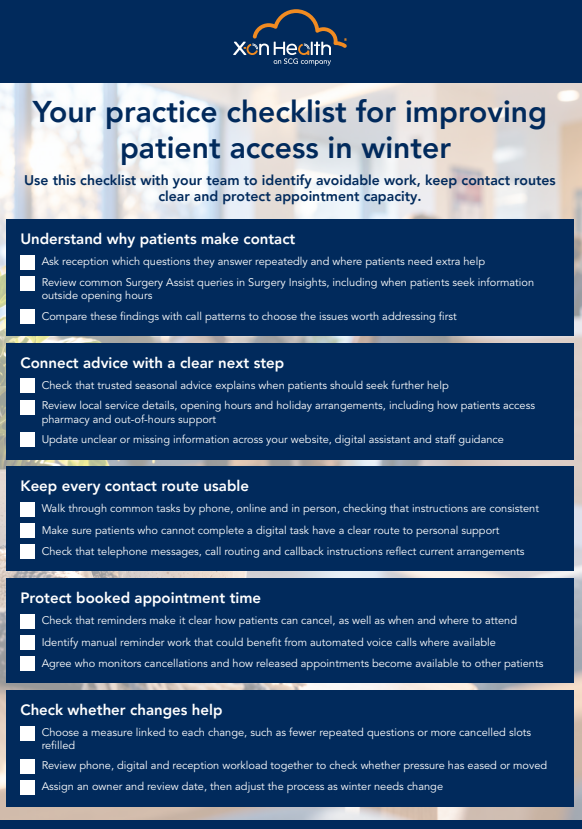
Improve patient access this winter with our practical checklist.
Winter brings added pressure on GP practices, making it important to reduce avoidable work, keep contact routes clear and protect appointment capacity.
Download our winter access checklist below for practical steps to help your team manage demand, improve patient communication and make the most of available capacity.